 Map of the Universe
Stephan's Quintet
Galaxy group · Visual grouping of five galaxies
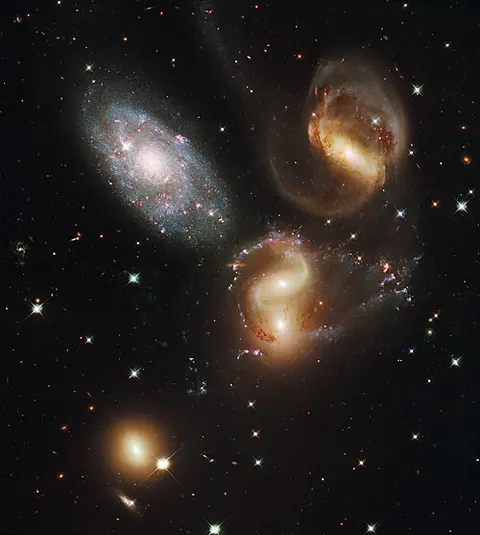
About Stephan's Quintet
The light we see from it set out 0.291 billion years ago, when the universe was 13.5 billion years old (redshift 0.02041).
The map lists it as a galaxy group and shows it at the scale of the large-scale universe, drawn on the supergalactic plane.
Key numbers
| Distance (comoving, today) | 0.294 billion light-years (90 Mpc) |
|---|---|
| Redshift z | 0.02041 |
| Light travel time | 0.291 billion years |
| Universe's age when this light left | 13.5 billion years |
| Distance method | redshift-independent (literature) |
| Supergalactic coordinates | SGL 327.5°, SGB +37.3° |
Where it is
Its place in the universe, from the inside out: Observable universe.
Zoom out to see it in context: Nearby superclusters, a view about 2.3 billion light-years across.
From Wikipedia
Stephan's Quintet is a visual grouping of five galaxies of which four form the first ever compact galaxy groups to be discovered. The group, visible in the constellation Pegasus, was discovered by Édouard Stephan in 1877 at the Marseille Observatory. The group is the heavily studied compact galaxy groups.
Excerpt from the Wikipedia article Stephan's Quintet, licensed CC BY-SA 4.0.
Nearby on the map
- Perseus–Pisces Supercluster Supercluster
- Zone of Avoidance Region / boundary
- Perseus Cluster Galaxy cluster
- Local Void Cosmic void
- Local Sheet Large-scale structure
- Eridanus Cluster Galaxy cluster