 Map of the Universe
Edge of the observable universe
Region / boundary · All of space observable from the Earth at the present
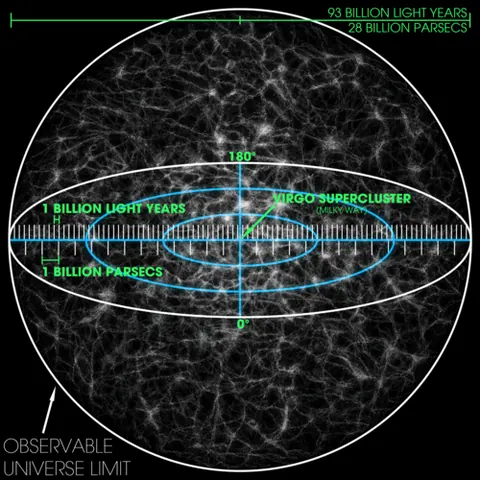
About Edge of the observable universe
The map lists it as a region / boundary (horizon) and shows it at the scale of the large-scale universe, drawn on the supergalactic plane.
The particle horizon: the farthest distance from which light could have reached us in 13.8 billion years, 46.2 billion light-years today (14.16 Gpc comoving, Planck 2018). The observable universe is about 92 billion light-years across.
Key numbers
| Distance (comoving, today) | 46.2 billion light-years (14,161 Mpc) |
|---|
Where it is
Its place in the universe, from the inside out: Observable universe.
Zoom out to see it in context: Observable universe, a view about 100 billion light-years across.
From Wikipedia
The observable universe is a spherical region of the universe consisting of all matter that can be observed from Earth; the electromagnetic radiation from these astronomical objects has had time to reach the Solar System and Earth since the beginning of the cosmological expansion.
Excerpt from the Wikipedia article Observable universe, licensed CC BY-SA 4.0.
Nearby on the map
- Dark ages (z ≈ 1100 to 20) Cosmic epoch
- Cosmic dawn (first stars, z ≈ 20) Cosmic epoch
- Cosmic microwave background Cosmic epoch
- ULAS J1342+0928 Quasar / active galaxy
- ULAS J1120+0641 Quasar / active galaxy
- GRB 090429B Explosion or burst