 Map of the Universe
Dark ages (z ≈ 1100 to 20)
Cosmic epoch · History and future of the universe
About Dark ages (z ≈ 1100 to 20)
The map lists it as a cosmic epoch and shows it at the scale of the large-scale universe, drawn on the supergalactic plane.
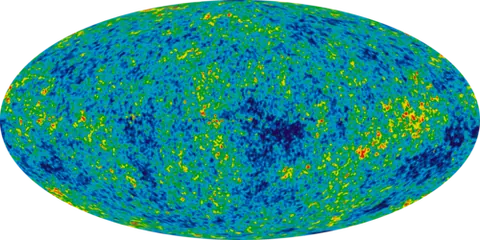
After the cosmic microwave background was released, the universe was a cooling fog of neutral hydrogen with no stars to light it, for about 100–200 million years. This ring marks z ≈ 60, about 35 million years after the Big Bang, the middle of that era on this map. Radio telescopes are searching for the faint 21 cm glow of that hydrogen.
Key numbers
| Distance (comoving, today) | 40.4 billion light-years (12,383 Mpc) |
|---|---|
| Redshift z | 60.02 |
| Light travel time | 13.75 billion years |
Where it is
Its place in the universe, from the inside out: Observable universe.
Zoom out to see it in context: Observable universe, a view about 100 billion light-years across.
From Wikipedia
The chronology of the universe describes the history and future of the universe according to the current understanding of physical cosmology. In this model, the earliest stage that is supported by observational evidence is known as inflation, which occurred 13.8 billion years ago.
Excerpt from the Wikipedia article Chronology of the universe, licensed CC BY-SA 4.0.
Nearby on the map
- Cosmic dawn (first stars, z ≈ 20) Cosmic epoch
- Edge of the observable universe Region / boundary
- ULAS J1342+0928 Quasar / active galaxy
- Cosmic microwave background Cosmic epoch
- ULAS J1120+0641 Quasar / active galaxy
- GRB 090429B Explosion or burst