 Map of the Universe
GRB 090429B
Explosion or burst · Gamma-ray burst in constellation Canes Venatici
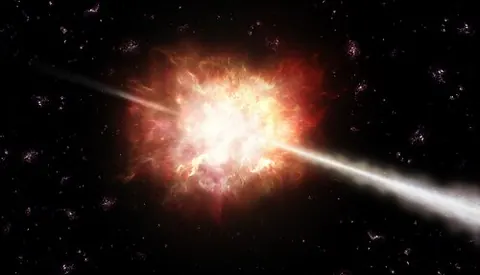
About GRB 090429B
The light we see from it set out 13.3 billion years ago, when the universe was 0.513 billion years old (redshift 9.4).
The map lists it as an explosion or burst and shows it at the scale of the large-scale universe, drawn on the supergalactic plane.
Its distance or nature is debated, and the map shows one published value.
Photometric redshift only.
Key numbers
| Distance (comoving, today) | 31 billion light-years (9,500 Mpc) |
|---|---|
| Redshift z | 9.4 |
| Light travel time | 13.3 billion years |
| Universe's age when this light left | 0.513 billion years |
| Distance method | redshift (Planck 2018 cosmology) |
| Supergalactic coordinates | SGL 87.6°, SGB +22.4° |
Where it is
Its place in the universe, from the inside out: Observable universe.
Zoom out to see it in context: Observable universe, a view about 100 billion light-years across.
From Wikipedia
GRB 090429B was a gamma-ray burst observed on 29 April 2009 by the Burst Alert Telescope aboard the Swift satellite. The burst triggered a standard burst-response observation sequence, which started 106 seconds after the burst. The X-ray telescope aboard the satellite identified an uncatalogued fading source.
Excerpt from the Wikipedia article GRB 090429B, licensed CC BY-SA 4.0.
Nearby on the map
- CAPERS-LRD-z9 Quasar / active galaxy
- ULAS J1342+0928 Quasar / active galaxy
- TON 618 Quasar / active galaxy
- Cosmic dawn (first stars, z ≈ 20) Cosmic epoch
- Cosmic noon (z ≈ 2) Cosmic epoch
- GN-z11 Galaxy