 Map of the Universe
CAPERS-LRD-z9
Quasar / active galaxy · Poorly understood class of astronomical objects
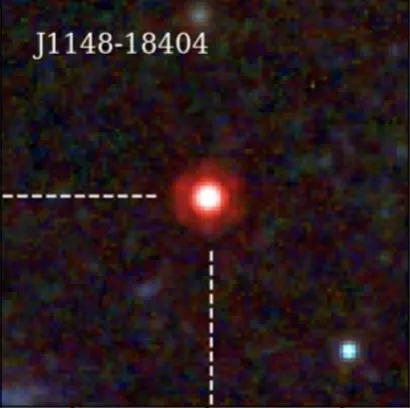
About CAPERS-LRD-z9
The light we see from it set out 13.3 billion years ago, when the universe was 0.521 billion years old (redshift 9.288).
The map lists it as a quasar / active galaxy and shows it at the scale of the large-scale universe, drawn on the supergalactic plane.
Its distance or nature is debated, and the map shows one published value.
The most distant confirmed black hole (a 'little red dot'). Sky position approximate (CAPERS field).
Key numbers
| Distance (comoving, today) | 30.9 billion light-years (9,474 Mpc) |
|---|---|
| Redshift z | 9.288 |
| Light travel time | 13.3 billion years |
| Universe's age when this light left | 0.521 billion years |
| Distance method | redshift (Planck 2018 cosmology) |
| Supergalactic coordinates | SGL 64.9°, SGB +25.2° |
Where it is
Its place in the universe, from the inside out: Observable universe.
Zoom out to see it in context: Observable universe, a view about 100 billion light-years across.
From Wikipedia
Little red dots (LRDs) are a class of small, red-tinted astronomical objects with unexpected characteristics observed using the James Webb Space Telescope (JWST). They appear to have existed between 0.6 and 1.6 billion years after the Big Bang, with a majority found around 600 million years post-Big Bang.
Excerpt from the Wikipedia article Little Red Dots, licensed CC BY-SA 4.0.
Nearby on the map
- GN-z11 Galaxy
- GRB 090429B Explosion or burst
- TON 618 Quasar / active galaxy
- Hercules–Corona Borealis Great Wall Large-scale structure
- Cosmic noon (z ≈ 2) Cosmic epoch
- Giant Arc Large-scale structure