 Map of the Universe
Hercules–Corona Borealis Great Wall
Large-scale structure · Possible large cosmic structure
About the Hercules–Corona Borealis Great Wall
The light we see from it set out 10.3 billion years ago, when the universe was 3.53 billion years old (redshift 1.85).
The map lists it as a large-scale structure and shows it at the scale of the large-scale universe, drawn on the supergalactic plane.
Its distance or nature is debated, and the map shows one published value.
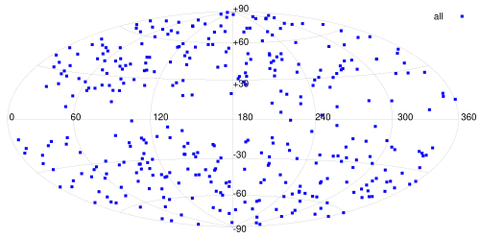
A claimed 10-billion-light-year concentration of gamma-ray bursts. Heavily contested.
Key numbers
| Distance (comoving, today) | 16.6 billion light-years (5,080 Mpc) |
|---|---|
| Redshift z | 1.85 |
| Light travel time | 10.3 billion years |
| Universe's age when this light left | 3.53 billion years |
| Distance method | redshift (Planck 2018 cosmology) |
| Supergalactic coordinates | SGL 87.2°, SGB +60.8° |
| On the map | The dashed circle marks its approximate size around its centre. Structures this large have no sharp edge, and the circle is not drawn to an exact shape. |
| Size | about 9.8 billion light-years across |
Where it is
Its place in the universe, from the inside out: Observable universe.
Zoom out to see it in context: Observable universe, a view about 100 billion light-years across.
From Wikipedia
The Hercules–Corona Borealis Great Wall (HCB) or simply the Great Wall or the Great Gamma-Ray Burst Wall is a putative galaxy filament that, if confirmed, would be one of the largest known structures in the observable universe, measuring approximately 10 billion light-years in length, or ~10.8% the length of the observable universe.
Excerpt from the Wikipedia article Hercules–Corona Borealis Great Wall, licensed CC BY-SA 4.0.
Nearby on the map
- Big Ring Large-scale structure
- Giant Arc Large-scale structure
- Abell 2218 Galaxy cluster
- Dark energy takes over (z ≈ 0.3) Cosmic epoch
- MACS J1149.5+2223 Galaxy cluster
- Abell 1689 Galaxy cluster