 Map of the Universe
Perseus Cluster
Galaxy cluster · Galaxy cluster in the constellation Perseus
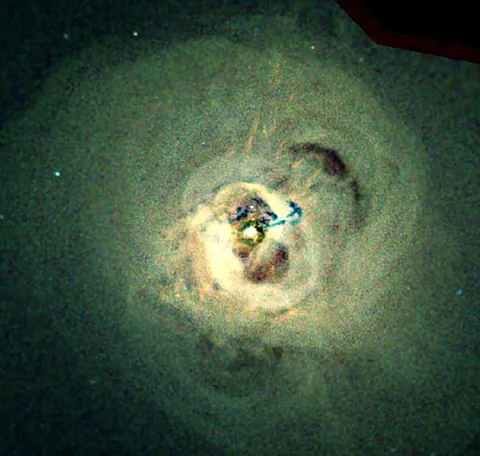
About the Perseus Cluster
The light we see from it set out 0.255 billion years ago, when the universe was 13.5 billion years old (redshift 0.0179).
The map lists it as a galaxy cluster and shows it at the scale of the large-scale universe, drawn on the supergalactic plane.
Its distance or nature is debated, and the map shows one published value.
The brightest X-ray cluster in the sky. Distance 73.6 Mpc (redshift-independent mean) or 79 Mpc (Hubble flow).
Key numbers
| Distance (comoving, today) | 0.258 billion light-years (79 Mpc) |
|---|---|
| Redshift z | 0.0179 |
| Light travel time | 0.255 billion years |
| Universe's age when this light left | 13.5 billion years |
| Distance method | redshift (Planck 2018 cosmology) |
| Supergalactic coordinates | SGL 347.9°, SGB -14.3° |
Where it is
Its place in the universe, from the inside out: Observable universe.
Zoom out to see it in context: Nearby superclusters, a view about 2.3 billion light-years across.
From Wikipedia
The Perseus Cluster is a cluster of galaxies in the constellation Perseus. It has a recession speed of 5,366 km/s and a diameter of 863′. It is one of the most massive objects in the known universe, containing thousands of galaxies immersed in a vast cloud of multimillion-degree gas.
Excerpt from the Wikipedia article Perseus Cluster, licensed CC BY-SA 4.0.
Nearby on the map
- Perseus–Pisces Supercluster Supercluster
- Zone of Avoidance Region / boundary
- Eridanus Cluster Galaxy cluster
- Fornax Cluster Galaxy cluster
- Local Sheet Large-scale structure
- Stephan's Quintet Galaxy group