 Map of the Universe
Dipole Repeller
Cosmic void · Center of effective repulsion in the large-scale flow of galaxies near the Milky Way
About Dipole Repeller
The light we see from it set out 0.697 billion years ago, when the universe was 13.1 billion years old (redshift 0.05).
The map lists it as a cosmic void and shows it at the scale of the large-scale universe, drawn on the supergalactic plane.
Its distance or nature is debated, and the map shows one published value.
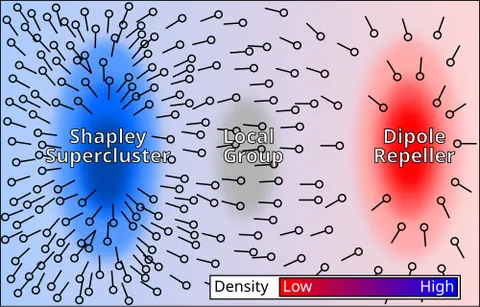
An underdense region that effectively pushes the Local Group away (Hoffman et al. 2017). Position approximate.
Key numbers
| Distance (comoving, today) | 0.714 billion light-years (219 Mpc) |
|---|---|
| Redshift z | 0.05 |
| Light travel time | 0.697 billion years |
| Universe's age when this light left | 13.1 billion years |
| Distance method | redshift (Planck 2018 cosmology) |
| Supergalactic coordinates | SGL 331.5°, SGB +38.1° |
| On the map | The dashed circle marks its approximate size around its centre. Structures this large have no sharp edge, and the circle is not drawn to an exact shape. |
| Size | about 326 million light-years across |
Where it is
Its place in the universe, from the inside out: Observable universe.
Zoom out to see it in context: Nearby superclusters, a view about 2.3 billion light-years across.
From Wikipedia
The dipole repeller is a center of effective repulsion in the large-scale flow of galaxies in the neighborhood of the Milky Way, first detected in 2017. It is thought to represent a large supervoid, the Dipole Repeller Void.
Excerpt from the Wikipedia article Dipole repeller, licensed CC BY-SA 4.0.
Nearby on the map
- Cygnus A Galaxy
- Stephan's Quintet Galaxy group
- Perseus–Pisces Supercluster Supercluster
- Zone of Avoidance Region / boundary
- Perseus Cluster Galaxy cluster
- Local Void Cosmic void