 Map of the Universe
Sloan Great Wall
Large-scale structure · Cosmic structure formed by a galaxy filament
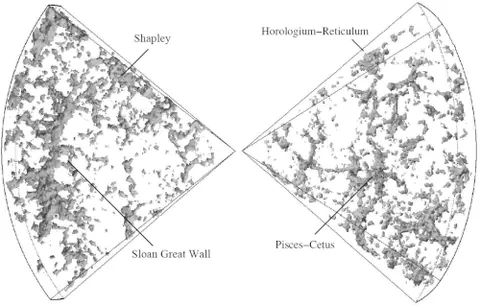
About the Sloan Great Wall
The light we see from it set out 1 billion years ago, when the universe was 12.8 billion years old (redshift 0.073).
The map lists it as a large-scale structure and shows it at the scale of the large-scale universe, drawn on the supergalactic plane.
A wall of galaxies about 1.37 billion light-years long (Gott et al. 2005).
Key numbers
| Distance (comoving, today) | 1.04 billion light-years (318 Mpc) |
|---|---|
| Redshift z | 0.073 |
| Light travel time | 1 billion years |
| Universe's age when this light left | 12.8 billion years |
| Distance method | redshift (Planck 2018 cosmology) |
| Supergalactic coordinates | SGL 118.7°, SGB +7.9° |
| On the map | The dashed circle marks its approximate size around its centre. Structures this large have no sharp edge, and the circle is not drawn to an exact shape. |
| Size | about 1.4 billion light-years across |
Where it is
Its place in the universe, from the inside out: Observable universe.
Zoom out to see it in context: Nearby superclusters, a view about 2.3 billion light-years across.
From Wikipedia
The Sloan Great Wall (SGW) is a cosmic structure formed by a giant wall of galaxies. Its discovery was announced from Princeton University on October 20, 2003, by J. Richard Gott III, Mario Jurić, and their colleagues, based on data from the Sloan Digital Sky Survey.
Excerpt from the Wikipedia article Sloan Great Wall, licensed CC BY-SA 4.0.
Nearby on the map
- Malin 1 Galaxy
- Abell 2029 Galaxy cluster
- IC 1101 Galaxy
- Shapley Supercluster Supercluster
- Corona Borealis Supercluster Supercluster
- Hercules Cluster Galaxy cluster