 Map of the Universe
Shapley Supercluster
Supercluster · Supercluster in the constellation Centaurus
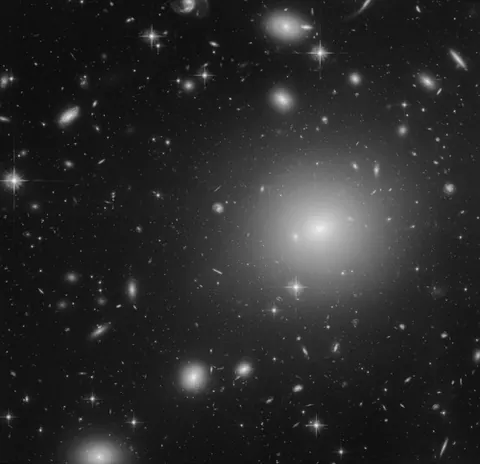
About the Shapley Supercluster
The light we see from it set out 0.656 billion years ago, when the universe was 13.1 billion years old (redshift 0.047).
The map lists it as a supercluster and shows it at the scale of the large-scale universe, drawn on the supergalactic plane.
The most massive concentration of galaxies within about a billion light-years.
Key numbers
| Distance (comoving, today) | 0.672 billion light-years (206 Mpc) |
|---|---|
| Redshift z | 0.047 |
| Light travel time | 0.656 billion years |
| Universe's age when this light left | 13.1 billion years |
| Distance method | redshift (Planck 2018 cosmology) |
| Supergalactic coordinates | SGL 148.9°, SGB -1.4° |
| On the map | The dashed circle marks its approximate size around its centre. Structures this large have no sharp edge, and the circle is not drawn to an exact shape. |
| Size | about 326 million light-years across |
Where it is
Its place in the universe, from the inside out: Observable universe.
Zoom out to see it in context: Nearby superclusters, a view about 2.3 billion light-years across.
From Wikipedia
The Shapley Supercluster or Shapley Concentration is one of the largest concentrations of galaxies in the observable universe that forms a bound, gravitationally interacting unit, thereby pulling itself together instead of expanding with the universe.
Excerpt from the Wikipedia article Shapley Supercluster, licensed CC BY-SA 4.0.
Nearby on the map
- Hydra–Centaurus Supercluster Supercluster
- Centaurus Cluster Galaxy cluster
- Ophiuchus Cluster Galaxy cluster
- ESO 137-001 Galaxy
- Norma Cluster Galaxy cluster
- Laniakea Supercluster Supercluster