 Map of the Universe
Ophiuchus Cluster
Galaxy cluster · Galaxy supercluster in the constellation Ophiuchus
About Ophiuchus Cluster
The light we see from it set out 0.396 billion years ago, when the universe was 13.4 billion years old (redshift 0.028).
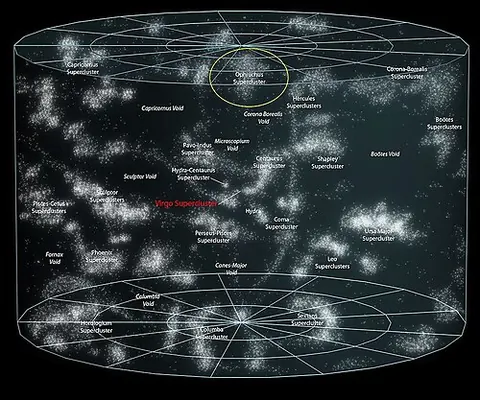
The map lists it as a galaxy cluster and shows it at the scale of the large-scale universe, drawn on the supergalactic plane.
Site of the largest known explosion: a black-hole eruption of 5 × 10⁶¹ erg (Giacintucci et al. 2020).
Key numbers
| Distance (comoving, today) | 0.402 billion light-years (123 Mpc) |
|---|---|
| Redshift z | 0.028 |
| Light travel time | 0.396 billion years |
| Universe's age when this light left | 13.4 billion years |
| Distance method | redshift (Planck 2018 cosmology) |
| Supergalactic coordinates | SGL 173.2°, SGB +43.6° |
Where it is
Its place in the universe, from the inside out: Observable universe.
Zoom out to see it in context: Laniakea, a view about 850 million light-years across.
From Wikipedia
The Ophiuchus Supercluster is a nearby galaxy supercluster in the constellation Ophiuchus. The supercluster forms the far wall of the Ophiuchus Void; it may also be connected in a filament with the Pavo-Indus-Telescopium and the Hercules Superclusters.
Excerpt from the Wikipedia article Ophiuchus Supercluster, licensed CC BY-SA 4.0.
Nearby on the map
- ESO 137-001 Galaxy
- Norma Cluster Galaxy cluster
- Laniakea Supercluster Supercluster
- Great Attractor Large-scale structure
- Pavo–Indus Supercluster Supercluster
- Centaurus Cluster Galaxy cluster