 Map of the Universe
Great Attractor
Large-scale structure · Region of gravitational attraction in the local universe
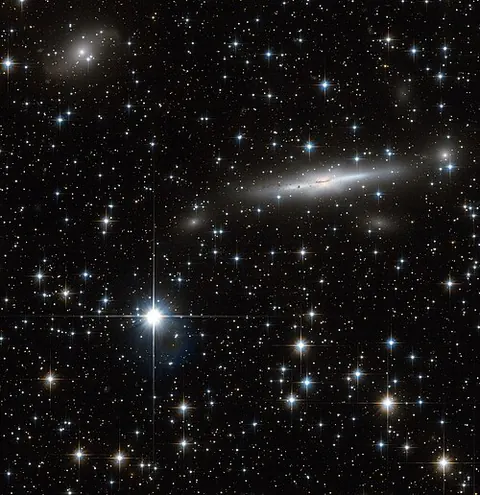
About the Great Attractor
The light we see from it set out 0.21 billion years ago, when the universe was 13.6 billion years old (redshift 0.01472).
The map lists it as a large-scale structure and shows it at the scale of the large-scale universe, drawn on the supergalactic plane.
A concentration of mass ~65 Mpc away, behind the Milky Way's disc, toward which the Local Group and thousands of galaxies flow. Its core is the Norma Cluster.
Key numbers
| Distance (comoving, today) | 0.212 billion light-years (65 Mpc) |
|---|---|
| Redshift z | 0.01472 |
| Light travel time | 0.21 billion years |
| Universe's age when this light left | 13.6 billion years |
| Distance method | redshift-independent (literature) |
| Supergalactic coordinates | SGL 188.1°, SGB +7.1° |
Where it is
Its place in the universe, from the inside out: Laniakea Supercluster › Observable universe.
Zoom out to see it in context: Laniakea, a view about 850 million light-years across.
From Wikipedia
The Great Attractor is a region of enhanced gravitational attraction in the local universe. It lies in the general direction of the Norma Cluster and the Hydra–Centaurus Supercluster, approximately 150–250 million light-years from the Milky Way.
Excerpt from the Wikipedia article Great Attractor, licensed CC BY-SA 4.0.
Nearby on the map
- Laniakea Supercluster Supercluster
- Norma Cluster Galaxy cluster
- ESO 137-001 Galaxy
- Centaurus Cluster Galaxy cluster
- Hydra–Centaurus Supercluster Supercluster
- Pavo–Indus Supercluster Supercluster