 Map of the Universe
Pegasus V
Dwarf galaxy · Dwarf satellite galaxy of Andromeda
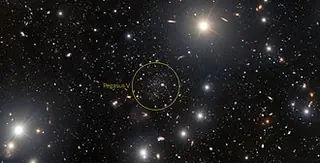
About Pegasus V
Pegasus V is about 2.26 million light-years from the Sun, so the light we see from it left about 2.26 million years ago.
The map lists it as a dwarf galaxy and shows it at the scale of the Milky Way and the Local Group, drawn on the plane of the Milky Way.
Key numbers
| Distance | 2.26 million light-years (0.69 Mpc) |
|---|---|
| Distance method | LVDB (RR Lyrae, TRGB or other) |
| Supergalactic coordinates | SGL 326.3°, SGB +28.5° |
| Absolute magnitude (V) | -6.3 |
| Stellar mass | 5.62 × 10⁴ suns |
Data: Local Volume Database v1.1.1 (Pace 2025).
Where it is
Its place in the universe, from the inside out: Local Group › Virgo Supercluster › Laniakea Supercluster › Observable universe.
Zoom out to see it in context: Local Group, a view about 10 million light-years across.
From Wikipedia
Pegasus V (Peg V), or Andromeda XXXIV (And XXXIV), is an ultra-faint dwarf galaxy and a minor satellite of the Andromeda Galaxy, located in the constellation Pegasus and discovered by the amateur astronomer Giuseppe Donatiello in 2022.
Excerpt from the Wikipedia article Pegasus V, licensed CC BY-SA 4.0.
Nearby on the map
- Andromeda III Dwarf galaxy
- Andromeda VI Dwarf galaxy
- Andromeda Galaxy Galaxy
- Andromeda I Dwarf galaxy
- NGC 185 Dwarf galaxy
- NGC 147 Dwarf galaxy