 Map of the Universe
Andromeda Galaxy
Galaxy · Barred spiral galaxy in the Local Group
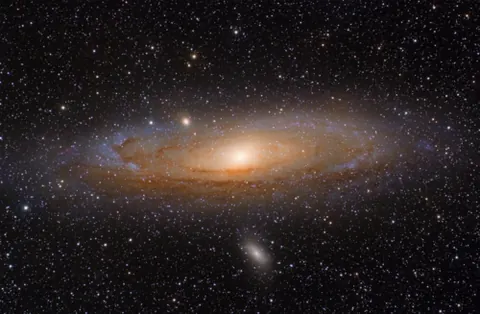
About the Andromeda Galaxy
The Andromeda Galaxy is about 2.48 million light-years from the Sun, so the light we see from it left about 2.48 million years ago.
The map lists it as a galaxy and shows it at the scale of the Milky Way and the Local Group, drawn on the plane of the Milky Way.
The nearest large galaxy, 2.5 million light-years away (761 ± 11 kpc, Li et al. 2021). It is falling toward the Milky Way at about 110 km/s; Sawala et al. 2025 give roughly even odds that the two merge within 10 billion years, and only ~2% within 5 billion.
Key numbers
| Distance | 2.48 million light-years (0.76 Mpc) |
|---|---|
| Distance method | LVDB (RR Lyrae, TRGB or other) |
| Supergalactic coordinates | SGL 336.2°, SGB +12.6° |
Data: Local Volume Database v1.1.1 (Pace 2025).
Where it is
Its place in the universe, from the inside out: Local Group › Virgo Supercluster › Laniakea Supercluster › Observable universe.
Zoom out to see it in context: Local Group, a view about 10 million light-years across.
From Wikipedia
The Andromeda Galaxy is a barred spiral galaxy and is the nearest major galaxy to the Milky Way. It was originally named the Andromeda Nebula and is cataloged as Messier 31, M31, and NGC 224.
Excerpt from the Wikipedia article Andromeda Galaxy, licensed CC BY-SA 4.0.
Nearby on the map
- Andromeda I Dwarf galaxy
- NGC 205 Dwarf galaxy
- Andromeda III Dwarf galaxy
- NGC 147 Dwarf galaxy
- Andromeda V Dwarf galaxy
- Andromeda XXXVI Dwarf galaxy