 Map of the Universe
Andromeda VI
Dwarf galaxy · Dwarf spheroidal galaxy in the constellation Pegasus
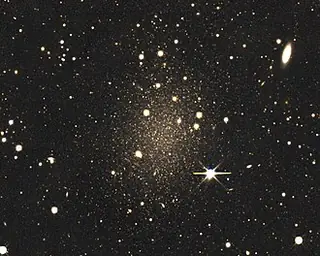
About Andromeda VI
Andromeda VI is about 2.71 million light-years from the Sun, so the light we see from it left about 2.71 million years ago.
The map lists it as a dwarf galaxy and shows it at the scale of the Milky Way and the Local Group, drawn on the plane of the Milky Way.
Key numbers
| Distance | 2.71 million light-years (0.83 Mpc) |
|---|---|
| Distance method | LVDB (RR Lyrae, TRGB or other) |
| Supergalactic coordinates | SGL 317.3°, SGB +20.6° |
| Absolute magnitude (V) | -11.3 |
| Stellar mass | 5.62 × 10⁶ suns |
Data: Local Volume Database v1.1.1 (Pace 2025).
Where it is
Its place in the universe, from the inside out: Local Group › Virgo Supercluster › Laniakea Supercluster › Observable universe.
Zoom out to see it in context: Local Group, a view about 10 million light-years across.
From Wikipedia
The Pegasus Dwarf Spheroidal (also known as Andromeda VI or Peg dSph for short) is a dwarf spheroidal galaxy about 2.7 million light-years away in the constellation Pegasus. The Pegasus Dwarf is a member of the Local Group and a satellite galaxy of the Andromeda Galaxy (M31).
Excerpt from the Wikipedia article Pegasus Dwarf Spheroidal Galaxy, licensed CC BY-SA 4.0.
Nearby on the map
- Pegasus V Dwarf galaxy
- Andromeda III Dwarf galaxy
- Andromeda I Dwarf galaxy
- Andromeda Galaxy Galaxy
- NGC 205 Dwarf galaxy
- LGS 3 Dwarf galaxy