 Map of the Universe
Earendel
Star · Distant star or star cluster
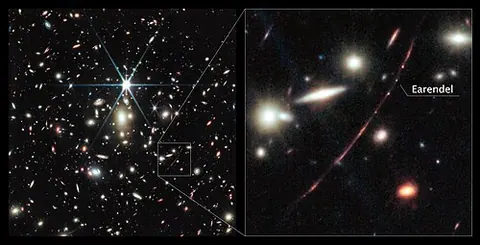
About Earendel
The light we see from it set out 12.9 billion years ago, when the universe was 0.891 billion years old (redshift 6.2).
The map lists it as a star (lensed star) and shows it at the scale of the large-scale universe, drawn on the supergalactic plane.
Its distance or nature is debated, and the map shows one published value.
The most distant single star claimed, magnified by a galaxy cluster. Whether it is one star or a star cluster is debated.
Key numbers
| Distance (comoving, today) | 27.8 billion light-years (8,509 Mpc) |
|---|---|
| Redshift z | 6.2 |
| Light travel time | 12.9 billion years |
| Universe's age when this light left | 0.891 billion years |
| Distance method | redshift (Planck 2018 cosmology) |
| Supergalactic coordinates | SGL 291.0°, SGB -12.4° |
Where it is
Its place in the universe, from the inside out: Observable universe.
Zoom out to see it in context: Observable universe, a view about 100 billion light-years across.
From Wikipedia
Earendel, designated WHL0137-LS, is a star cluster or a star located in the constellation of Cetus. Discovered in 2022 with the Hubble Space Telescope, it has a comoving distance of 28 billion light-years, making it the most distant known star if it is a single object.
Excerpt from the Wikipedia article Earendel (astronomical object), licensed CC BY-SA 4.0.
Nearby on the map
- J0313-1806 Quasar / active galaxy
- A2744-z7p9OD Galaxy cluster
- UHZ1 Quasar / active galaxy
- FRB 20220610A Explosion or burst
- El Gordo Galaxy cluster
- Phoenix Cluster Galaxy cluster