 Map of the Universe
FRB 20220610A
Explosion or burst · Astronomical high energy transient pulse
About FRB 20220610A
The light we see from it set out 8 billion years ago, when the universe was 5.79 billion years old (redshift 1.016).
The map lists it as an explosion or burst and shows it at the scale of the large-scale universe, drawn on the supergalactic plane.
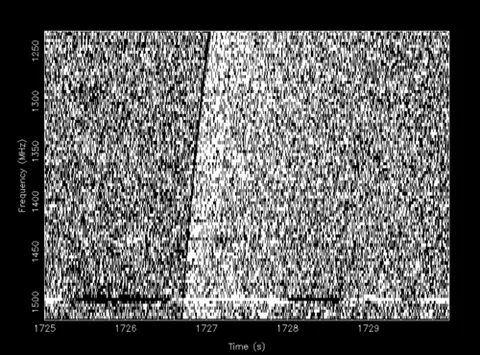
A fast radio burst from 8 billion years ago (Ryder et al. 2023), held the distance record until FRB 20240304B.
Key numbers
| Distance (comoving, today) | 11.2 billion light-years (3,435 Mpc) |
|---|---|
| Redshift z | 1.016 |
| Light travel time | 8 billion years |
| Universe's age when this light left | 5.79 billion years |
| Distance method | redshift (Planck 2018 cosmology) |
| Supergalactic coordinates | SGL 257.7°, SGB +9.2° |
Where it is
Its place in the universe, from the inside out: Observable universe.
Zoom out to see it in context: Observable universe, a view about 100 billion light-years across.
From Wikipedia
In radio astronomy, a fast radio burst (FRB) is a transient radio wave of duration ranging from a fraction of a millisecond, for an ultra-fast radio burst, to 3 seconds, caused by a high-energy astrophysical process that is not yet understood.
Excerpt from the Wikipedia article Fast radio burst, licensed CC BY-SA 4.0.
Nearby on the map
- Phoenix Cluster Galaxy cluster
- El Gordo Galaxy cluster
- Saraswati Supercluster Supercluster
- Abell 370 Galaxy cluster
- Eridanus Supervoid Cosmic void
- KBC Void Cosmic void