 Map of the Universe
KBC Void
Cosmic void · Large, comparatively empty region of space
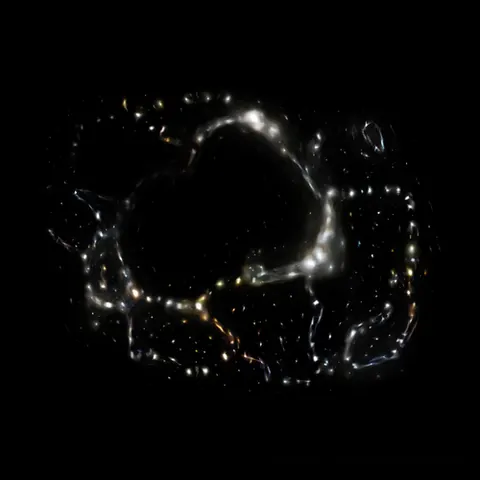
About KBC Void
The map lists it as a cosmic void and shows it at the scale of the large-scale universe, drawn on the supergalactic plane.
Its distance or nature is debated, and the map shows one published value.
A proposed underdensity about 2 billion light-years across with the Milky Way near its middle: counts of galaxies suggest space around us out to ~300 Mpc holds 20–50% fewer galaxies than average (Keenan, Barger & Cowie 2013). It could explain part of the Hubble tension, but a hole this large and deep would be very rare in standard cosmology, and other surveys find a much weaker one.
Key numbers
| Centre | Around the Milky Way: we would be inside it |
|---|---|
| On the map | The dashed circle marks its approximate size around its centre. Structures this large have no sharp edge, and the circle is not drawn to an exact shape. |
| Size | about 2 billion light-years across |
| Distance from the Sun | 978 million light-years |
Where it is
Its place in the universe, from the inside out: Observable universe.
Zoom out to see it in context: Nearby superclusters, a view about 2.3 billion light-years across.
From Wikipedia
The Local Hole, also known as the KBC Void, is an immense, comparatively empty region of space, named after astronomers Ryan Keenan, Amy Barger, and Lennox Cowie, who studied it in 2013. The existence of a local underdensity has been the subject of many pieces of literature and research articles.
Excerpt from the Wikipedia article Local Hole, licensed CC BY-SA 4.0.
Nearby on the map
- South Pole Wall Large-scale structure
- Horologium–Reticulum Supercluster Supercluster
- Sculptor Void Cosmic void
- Pavo–Indus Supercluster Supercluster
- Norma Cluster Galaxy cluster
- ESO 137-001 Galaxy