 Map of the Universe
A2744-z7p9OD
Galaxy cluster · Galaxy cluster in the constellation Sculptor
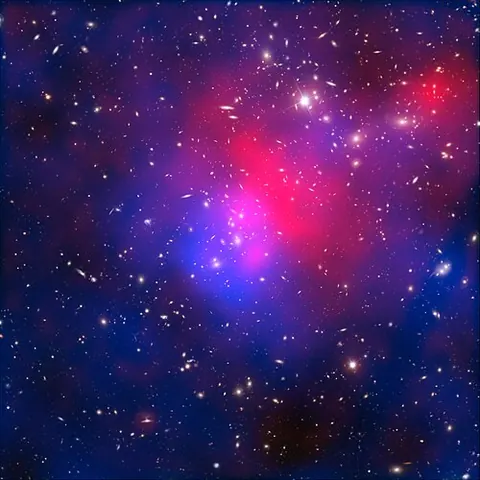
About A2744-z7p9OD
The light we see from it set out 13.1 billion years ago, when the universe was 0.65 billion years old (redshift 7.88).
The map lists it as a galaxy cluster and shows it at the scale of the large-scale universe, drawn on the supergalactic plane.
The most distant spectroscopically confirmed protocluster, seen 13.1 billion years ago.
Key numbers
| Distance (comoving, today) | 29.7 billion light-years (9,096 Mpc) |
|---|---|
| Redshift z | 7.88 |
| Light travel time | 13.1 billion years |
| Universe's age when this light left | 0.65 billion years |
| Distance method | redshift (Planck 2018 cosmology) |
| Supergalactic coordinates | SGL 264.6°, SGB +0.6° |
Where it is
Its place in the universe, from the inside out: Observable universe.
Zoom out to see it in context: Observable universe, a view about 100 billion light-years across.
From Wikipedia
Abell 2744, nicknamed Pandora's Cluster, is a giant galaxy cluster resulting from the simultaneous pile-up of at least four separate, smaller galaxy clusters that took place over a span of 350 million years, and is located approximately 4 billion light years from Earth.
Excerpt from the Wikipedia article Abell 2744, licensed CC BY-SA 4.0.
Nearby on the map
- UHZ1 Quasar / active galaxy
- Earendel Star
- FRB 20220610A Explosion or burst
- El Gordo Galaxy cluster
- J0313-1806 Quasar / active galaxy
- Phoenix Cluster Galaxy cluster