 Map of the Universe
Procyon
Star · Star in the constellation Canis Minor
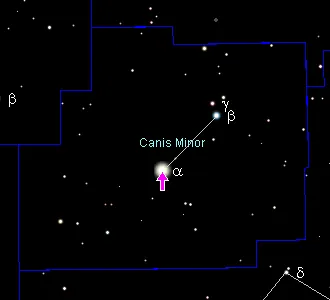
About Procyon
Procyon is about 11.46 light-years from the Sun, so the light we see from it left about 11.46 years ago.
At apparent magnitude 0.40 it can be seen with the naked eye from a dark site.
It gives out 7.44 times as much light as the Sun.
The map lists it as a star and shows it among the stars around the Sun, drawn on the plane of the Milky Way.
Key numbers
| Distance | 11.46 light-years (3.51 pc) |
|---|---|
| Spectral type | F5IV-V |
| Apparent magnitude | 0.40 |
| Absolute magnitude | 2.67 |
| Luminosity | 7.44 × the Sun |
| Constellation | CMi |
Where it is
Its place in the universe, from the inside out: Solar neighbourhood › Local Bubble › Orion–Cygnus Arm (Local Arm) › Milky Way › Local Group › Virgo Supercluster › Laniakea Supercluster › Observable universe.
Zoom out to see it in context: Nearest stars, a view about 24 light-years across.
From Wikipedia
Procyon is the brightest star in the constellation of Canis Minor and usually the eighth-brightest star in the night sky, with an apparent visual magnitude of 0.34. It has the Bayer designation α Canis Minoris, which is Latinized to Alpha Canis Minoris, and abbreviated α CMi or Alpha CMi, respectively.
Excerpt from the Wikipedia article Procyon, licensed CC BY-SA 4.0.