 Map of the Universe
Lalande 21185
Star · Star in the constellation Ursa Major
About Lalande 21185
Lalande 21185 is about 8.31 light-years from the Sun, so the light we see from it left about 8.31 years ago.
At apparent magnitude 7.49 it is too faint for the naked eye but within reach of binoculars.
It gives out 5.7 × 10⁻³ times as much light as the Sun.
It has 2 known planets.
The map lists it as a star and shows it among the stars around the Sun, drawn on the plane of the Milky Way.
Key numbers
| Distance | 8.31 light-years (2.55 pc) |
|---|---|
| Spectral type | M2V |
| Apparent magnitude | 7.49 |
| Absolute magnitude | 10.46 |
| Luminosity | 5.7 × 10⁻³ × the Sun |
| Constellation | UMa |
| Known planets | 2 |
Planets: NASA Exoplanet Archive (Planetary Systems Composite Parameters).
Known planets
| Planet | Mass (Earth = 1) | Radius (Earth = 1) | Orbit (days) | Found |
|---|---|---|---|---|
| GJ 411 b | 2.69 | 1.45 | 12.9394 | 2019, radial velocity |
| HD 95735 c | 13.6 | 3.76 | 2946 | 2021, radial velocity |
Where it is
Its place in the universe, from the inside out: Solar neighbourhood › Local Bubble › Orion–Cygnus Arm (Local Arm) › Milky Way › Local Group › Virgo Supercluster › Laniakea Supercluster › Observable universe.
Zoom out to see it in context: Nearest stars, a view about 24 light-years across.
From Wikipedia
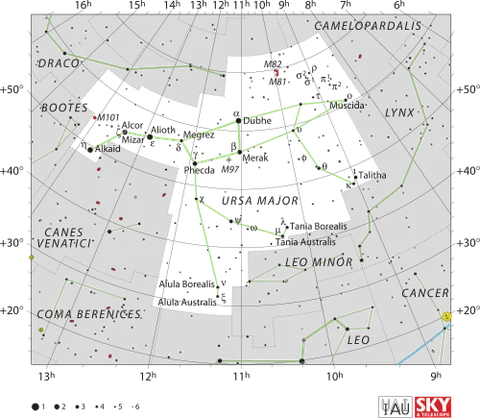
Lalande 21185 is a star in the south of Ursa Major. It is the apparent brightest red dwarf in the northern hemisphere. Despite this, and being relatively close by, it is very dim, being only magnitude 7.5 in visible light and thus too faint to be seen with the unaided eye.
Excerpt from the Wikipedia article Lalande 21185, licensed CC BY-SA 4.0.