 Map of the Universe
Omega Centauri
Globular cluster · Globular cluster in the constellation Centaurus
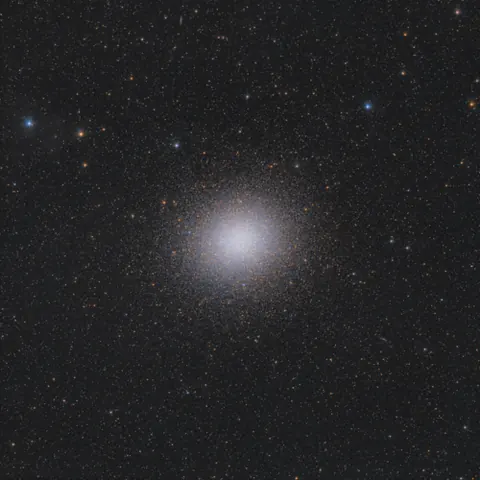
About Omega Centauri
Omega Centauri is about 17,710 light-years from the Sun, so the light we see from it left about 17,710 years ago.
It is 21,458 light-years from the centre of the Milky Way.
The map lists it as a globular cluster and shows it among the stars around the Sun, drawn on the plane of the Milky Way.
The largest globular cluster in the Galaxy (4 million suns), probably the core of a captured dwarf galaxy. Hosts an intermediate-mass black hole of at least 8,200 suns (Häberle et al. 2024).
Key numbers
| Distance | 17,710 light-years (5.43 kpc) |
|---|---|
| Distance from the Galactic centre | 21,458 light-years |
| Galactic coordinates | l = 309.10°, b = +14.97° |
| Absolute magnitude (V) | -10.5 |
| Stellar mass | 2.82 × 10⁶ suns |
| Half-light radius | 25 light-years |
Data: Local Volume Database v1.1.1 (Pace 2025).
Where it is
Its place in the universe, from the inside out: Milky Way › Local Group › Virgo Supercluster › Laniakea Supercluster › Observable universe.
Zoom out to see it in context: Local Arm, a view about 12,000 light-years across.
From Wikipedia
Omega Centauri is a globular cluster in the constellation of Centaurus that was first identified as a non-stellar object by Edmond Halley in 1677. Located at a distance of 17,090 light-years, it is the largest known globular cluster in the Milky Way at a diameter of roughly 150 light-years.
Excerpt from the Wikipedia article Omega Centauri, licensed CC BY-SA 4.0.
Nearby on the map
- Westerlund 2 Open star cluster
- Westerlund 1 Open star cluster
- Carina Nebula Nebula
- SN 1006 Supernova remnant
- M4 Globular cluster
- Gaia BH2 Black hole