 Map of the Universe
M15
Globular cluster · Globular cluster in the constellation Pegasus
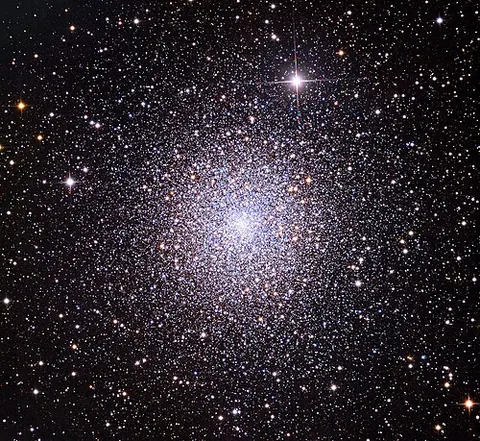
About M15
M15 is about 34,931 light-years from the Sun, so the light we see from it left about 34,931 years ago.
It is 35,199 light-years from the centre of the Milky Way.
The map lists it as a globular cluster and shows it among the stars around the Sun, drawn on the plane of the Milky Way.
Key numbers
| Distance | 34,931 light-years (10.71 kpc) |
|---|---|
| Distance from the Galactic centre | 35,199 light-years |
| Galactic coordinates | l = 65.01°, b = -27.31° |
| Absolute magnitude (V) | -9.2 |
| Stellar mass | 7.94 × 10⁵ suns |
| Half-light radius | 7 light-years |
Data: Local Volume Database v1.1.1 (Pace 2025).
Where it is
Its place in the universe, from the inside out: Milky Way › Local Group › Virgo Supercluster › Laniakea Supercluster › Observable universe.
Zoom out to see it in context: Local Arm, a view about 12,000 light-years across.
From Wikipedia
Messier 15 or M15 is a globular cluster in the constellation Pegasus. It was discovered by Jean-Dominique Maraldi in 1746 and included in Charles Messier's catalogue of comet-like objects in 1764. At an estimated 12.5±1.3 billion years old, it is one of the oldest known globular clusters.
Excerpt from the Wikipedia article Messier 15, licensed CC BY-SA 4.0.
Nearby on the map
- Solar circle Galactic structure
- SGR 1935+2154 Neutron star
- Westerhout 49 Nebula
- Hulse–Taylor pulsar Pulsar
- SS 433 Black hole
- Scutum–Centaurus Arm Galactic structure