 Map of the Universe
SS 433
Black hole · Binary star system in the constellation Aquila
About SS 433
SS 433 is about 17,939 light-years from the Sun, so the light we see from it left about 17,939 years ago.
It is 17,488 light-years from the centre of the Milky Way.
The map lists it as a black hole and shows it among the stars around the Sun, drawn on the plane of the Milky Way.
A microquasar whose jets move at 26% of the speed of light. The compact object may be a black hole or neutron star.
Key numbers
| Distance | 17,939 light-years (5.50 kpc) |
|---|---|
| Distance from the Galactic centre | 17,488 light-years |
| Galactic coordinates | l = 39.70°, b = -2.20° |
Where it is
Its place in the universe, from the inside out: Milky Way › Local Group › Virgo Supercluster › Laniakea Supercluster › Observable universe.
Zoom out to see it in context: Local Arm, a view about 12,000 light-years across.
From Wikipedia
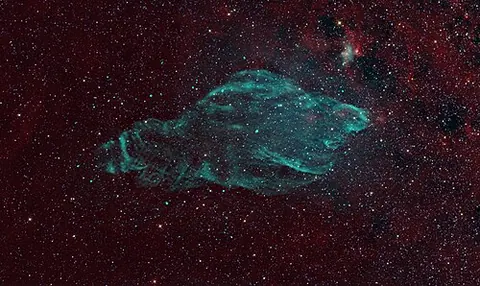
SS 433 is a microquasar or eclipsing X-ray binary system, consisting of a stellar-mass black hole accreting matter from an A-type companion star. SS 433 is the first discovered microquasar. It is at the centre of the supernova remnant W50.
Excerpt from the Wikipedia article SS 433, licensed CC BY-SA 4.0.
Nearby on the map
- Hulse–Taylor pulsar Pulsar
- Scutum–Centaurus Arm Galactic structure
- SGR 1935+2154 Neutron star
- NGC 6791 Open star cluster
- Solar circle Galactic structure
- M22 Globular cluster