 Map of the Universe
Kuiper belt
Region / boundary · Area of the Solar System beyond the planets, comprising small bodies
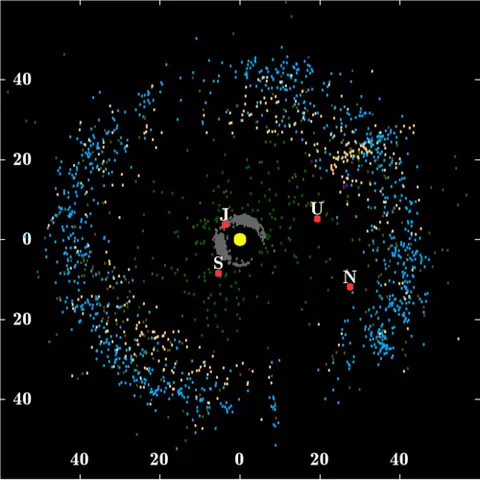
About the Kuiper belt
On 2026-01-01, the date the map shows, the Kuiper belt was 30 AU from the Sun; sunlight takes 4.16 hours to reach it.
The map lists it as a region / boundary and shows it in the Solar System part of the map, drawn on the plane of Earth’s orbit (the ecliptic).
Icy bodies from Neptune's orbit (30 AU) out to the 'Kuiper cliff' near 48–50 AU.
Key numbers
| Distance from the Sun | 30 AU – 50 AU |
|---|
Where it is
Its place in the universe, from the inside out: Solar System › Orion–Cygnus Arm (Local Arm) › Milky Way › Local Group › Virgo Supercluster › Laniakea Supercluster › Observable universe.
Zoom out to see it in context: Neptune and the Kuiper belt, a view about 110 AU across.
From Wikipedia
The Kuiper belt is a circumstellar disc in the outer Solar System, extending from the orbit of Neptune at 30 astronomical units (AU) to approximately 50 AU from the Sun. It is similar to the asteroid belt, but is far larger—20 times as wide and 20–200 times as massive.
Excerpt from the Wikipedia article Kuiper belt, licensed CC BY-SA 4.0.