 Map of the Universe
Europa
Moon · Smallest Galilean moon of Jupiter
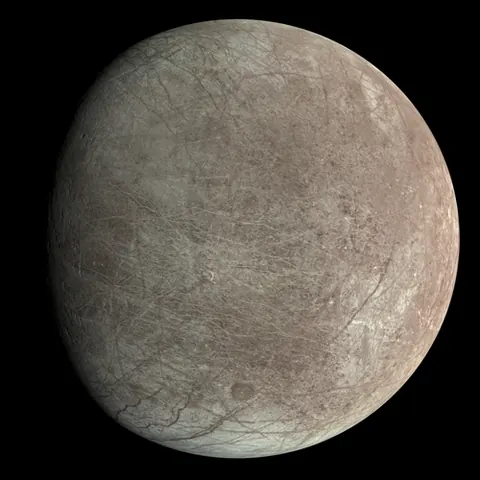
About Europa
On 2026-01-01, the date the map shows, Europa was 5.21 AU from the Sun; sunlight takes 43.3 minutes to reach it.
It goes round its planet once every 3.55 days, 671,310 km away on average.
It is about 3,122 km across.
The map lists it as a moon and shows it in the Solar System part of the map, drawn on the plane of Earth’s orbit (the ecliptic).
Key numbers
| Orbit radius (semi-major axis) | 671,310 km |
|---|---|
| Orbital period | 3.55 days |
| Eccentricity | 0.0093 |
| Inclination | 2.15° |
| Radius | 1,560.8 km |
| Distance from the Sun | 5.21 AU |
Where it is
Its place in the universe, from the inside out: Jupiter › Solar System › Orion–Cygnus Arm (Local Arm) › Milky Way › Local Group › Virgo Supercluster › Laniakea Supercluster › Observable universe.
Zoom out to see it in context: Jupiter's orbit, a view about 14 AU across.
From Wikipedia
Europa or Jupiter II is the smallest and least massive of Jupiter's four Galilean moons. It is observable from Earth with common binoculars and is a planetary-mass moon, slightly smaller and less massive than Earth's Moon. Europa is an icy moon, and, of the three icy Galilean moons, the closest orbiting Jupiter.
Excerpt from the Wikipedia article Europa (moon), licensed CC BY-SA 4.0.