 Map of the Universe
Betelgeuse
Star · Red supergiant star in the constellation Orion
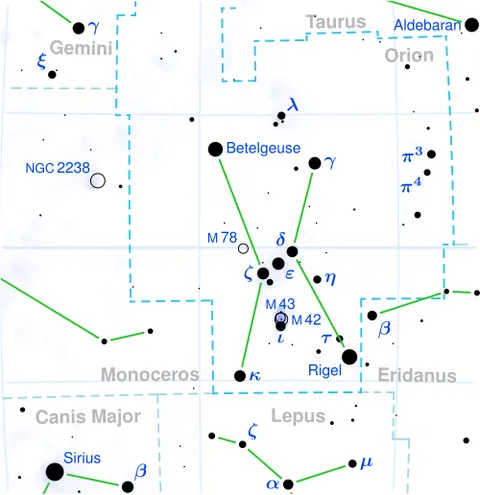
About Betelgeuse
Betelgeuse is about 497.95 light-years from the Sun, so the light we see from it left about 497.95 years ago.
At apparent magnitude 0.45 it can be seen with the naked eye from a dark site.
It gives out 1.34e+04 times as much light as the Sun.
The map lists it as a star and shows it among the stars around the Sun, drawn on the plane of the Milky Way.
Its distance or nature is debated, and the map shows one published value.
Distance contested: about 548 ly (+90 / −49). A red supergiant expected to explode as a supernova within roughly 100,000 years.
Key numbers
| Distance | 497.95 light-years (152.67 pc) |
|---|---|
| Spectral type | M2Ib |
| Apparent magnitude | 0.45 |
| Absolute magnitude | -5.47 |
| Luminosity | 1.34e+04 × the Sun |
| Constellation | Ori |
Where it is
Its place in the universe, from the inside out: Solar neighbourhood › Orion–Cygnus Arm (Local Arm) › Milky Way › Local Group › Virgo Supercluster › Laniakea Supercluster › Observable universe.
Zoom out to see it in context: 1,000 light-years, a view about 2,400 light-years across.
From Wikipedia
Betelgeuse is a red supergiant star in the equatorial constellation of Orion. It is usually the tenth-brightest star in the night sky and, after Rigel, the second brightest in its constellation.
Excerpt from the Wikipedia article Betelgeuse, licensed CC BY-SA 4.0.