 Map of the Universe
Arrokoth
Asteroid · Kuiper belt object
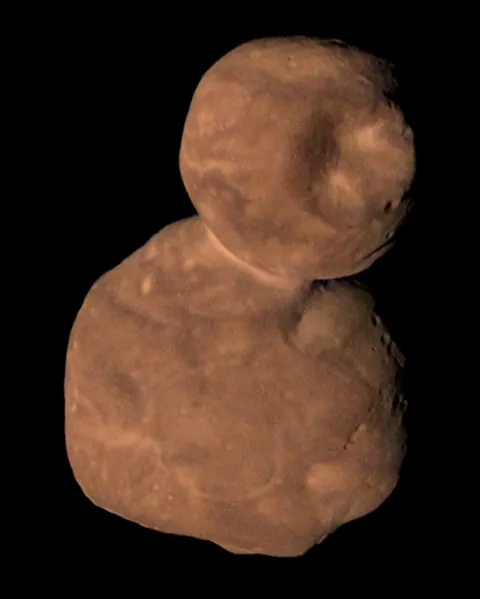
About Arrokoth
On 2026-01-01, the date the map shows, Arrokoth was 43.1 AU from the Sun; sunlight takes 5.97 hours to reach it.
It goes round the Sun once every 292.5 years, at an average distance of 44.059 AU.
It is about 36 km across.
The map lists it as an asteroid and shows it in the Solar System part of the map, drawn on the plane of Earth’s orbit (the ecliptic).
Visited by New Horizons on 2019-01-01 at 44.1 AU: the most distant object ever explored up close.
Key numbers
| Semi-major axis | 44.059 AU |
|---|---|
| Orbital period | 292.5 years |
| Eccentricity | 0.0361 |
| Inclination | 2.45° |
| Radius | 18.0 km |
| Distance from the Sun | 43.1 AU |
Where it is
Its place in the universe, from the inside out: Solar System › Orion–Cygnus Arm (Local Arm) › Milky Way › Local Group › Virgo Supercluster › Laniakea Supercluster › Observable universe.
Zoom out to see it in context: Neptune and the Kuiper belt, a view about 110 AU across.
From Wikipedia
486958 Arrokoth (provisional designation 2014 MU69; formerly nicknamed Ultima Thule) is a small, icy Kuiper belt object orbiting the Sun beyond Neptune and Pluto. It became the farthest object in the Solar System visited by a spacecraft when the NASA space probe New Horizons flew past it on 1 January 2019.
Excerpt from the Wikipedia article 486958 Arrokoth, licensed CC BY-SA 4.0.