 Map of the Universe
Uranus
Planet · Seventh planet from the Sun
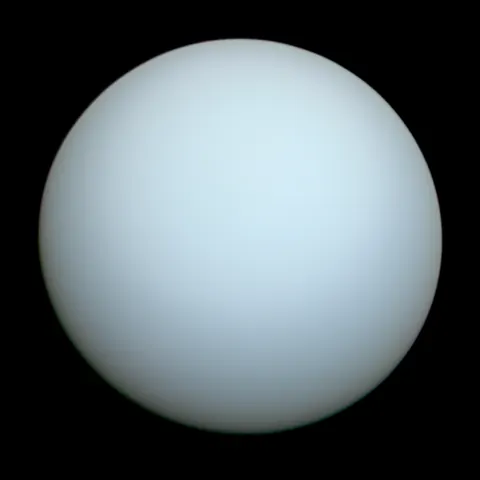
About Uranus
On 2026-01-01, the date the map shows, Uranus was 19.5 AU from the Sun; sunlight takes 2.7 hours to reach it.
It goes round the Sun once every 84.7 years, at an average distance of 19.284 AU.
It is about 50,720 km across.
The map lists it as a planet and shows it in the Solar System part of the map, drawn on the plane of Earth’s orbit (the ecliptic).
Key numbers
| Semi-major axis | 19.284 AU |
|---|---|
| Orbital period | 84.7 years |
| Eccentricity | 0.0468 |
| Inclination | 0.77° |
| Mass | 8.68 × 10²⁵ kg |
| Radius | 25,362.0 km |
| Day length | 17.2 h |
| Mean temperature | −195 °C (1 bar) |
| Distance from the Sun | 19.5 AU |
Where it is
Its place in the universe, from the inside out: Solar System › Orion–Cygnus Arm (Local Arm) › Milky Way › Local Group › Virgo Supercluster › Laniakea Supercluster › Observable universe.
Zoom out to see it in context: Neptune and the Kuiper belt, a view about 110 AU across.
From Wikipedia
Uranus is the seventh planet from the Sun. It is a gaseous cyan-coloured ice giant. Most of the planet is made of water, ammonia, and methane in a supercritical phase of matter, which astronomers call "ice" or "volatiles".
Excerpt from the Wikipedia article Uranus, licensed CC BY-SA 4.0.