 Map of the Universe
Salacia
Asteroid · Possible dwarf planet
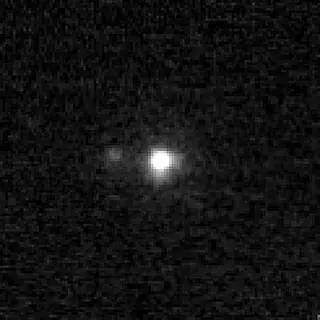
About Salacia
On 2026-01-01, the date the map shows, Salacia was 45.3 AU from the Sun; sunlight takes 6.28 hours to reach it.
It goes round the Sun once every 272.7 years, at an average distance of 42.055 AU.
The map lists it as an asteroid (trans-Neptunian object) and shows it in the Solar System part of the map, drawn on the plane of Earth’s orbit (the ecliptic).
Key numbers
| Class | Trans-Neptunian object |
|---|---|
| Semi-major axis | 42.055 AU |
| Orbital period | 272.7 years |
| Eccentricity | 0.1046 |
| Inclination | 23.93° |
| Absolute magnitude (H) | 4.12 |
| Diameter | ≈ 630 km (estimated from brightness) |
| Distance from the Sun | 45.3 AU |
Where it is
Its place in the universe, from the inside out: Solar System › Orion–Cygnus Arm (Local Arm) › Milky Way › Local Group › Virgo Supercluster › Laniakea Supercluster › Observable universe.
Zoom out to see it in context: Neptune and the Kuiper belt, a view about 110 AU across.
From Wikipedia
120347 Salacia (provisional designation 2004 SB60) is a large trans-Neptunian object in the Kuiper belt. It was discovered on 22 September 2004 by American astronomers Henry G. Roe, Michael E. Brown, and Kristina Barkume using the Hale Reflector at the Palomar Observatory.
Excerpt from the Wikipedia article 120347 Salacia, licensed CC BY-SA 4.0.