 Map of the Universe
PSR B1919+21
Pulsar · Pulsar in the constellation Vulpecula
About PSR B1919+21
PSR B1919+21 is about 978 light-years from the Sun, so the light we see from it left about 978 years ago.
It is 26,459 light-years from the centre of the Milky Way.
The map lists it as a pulsar and shows it among the stars around the Sun, drawn on the plane of the Milky Way.
Its distance or nature is debated, and the map shows one published value.
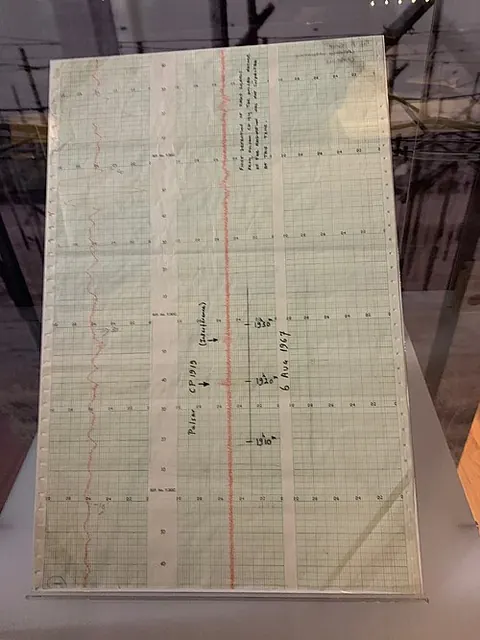
The first pulsar discovered (Jocelyn Bell Burnell, 1967). Its distance from dispersion measure is uncertain.
Key numbers
| Distance | 978 light-years (300 pc) |
|---|---|
| Distance from the Galactic centre | 26,459 light-years |
| Galactic coordinates | l = 55.78°, b = +3.50° |
| Spin period | 1.34e+03 ms |
| Distance method | independent (parallax or association) |
Data: ATNF Pulsar Catalogue v2.9.0.
Where it is
Its place in the universe, from the inside out: Milky Way › Local Group › Virgo Supercluster › Laniakea Supercluster › Observable universe.
Zoom out to see it in context: 1,000 light-years, a view about 2,400 light-years across.
From Wikipedia
PSR B1919+21 is a pulsar with a period of 1.3373 seconds and a pulse width of 0.04 seconds. Discovered by Jocelyn Bell Burnell on 28 November 1967, it is the first-discovered radio pulsar.
Excerpt from the Wikipedia article PSR B1919+21, licensed CC BY-SA 4.0.
Nearby on the map
- Dumbbell Nebula Planetary nebula
- Deneb Star
- RX J1856.5-3754 Neutron star
- Antares Star
- Helix Nebula Planetary nebula
- Polaris Star