 Map of the Universe
Oort cloud
Region / boundary · Distant planetesimals in the Solar System
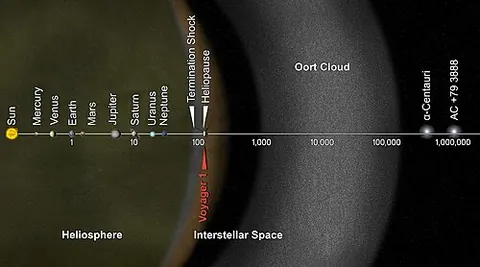
About Oort cloud
On 2026-01-01, the date the map shows, Oort cloud was 0.316 light-years from the Sun; sunlight takes 116 days to reach it.
The map lists it as a region / boundary and shows it in the Solar System part of the map, drawn on the plane of Earth’s orbit (the ecliptic).
Its existence is not confirmed: it is shown where it has been proposed.
Hypothetical outer shell of trillions of icy bodies, from about 20,000 AU to 100,000 AU or more. Never observed directly.
Key numbers
| Distance from the Sun | 20,000 AU – 100,000 AU |
|---|
Where it is
Its place in the universe, from the inside out: Solar System › Orion–Cygnus Arm (Local Arm) › Milky Way › Local Group › Virgo Supercluster › Laniakea Supercluster › Observable universe.
Zoom out to see it in context: Oort cloud, a view about 4 light-years across.
From Wikipedia
The Oort cloud, sometimes called the Öpik–Oort cloud, is theorized to be a cloud of billions of icy planetesimals surrounding the Sun at distances ranging from 2,000 to 200,000 AU. Its existence was proposed in 1950 by the Dutch astronomer Jan Oort, in whose honor the idea was later named.
Excerpt from the Wikipedia article Oort cloud, licensed CC BY-SA 4.0.
Nearby on the map
- Heliopause Region / boundary
- Pioneer 10 Spacecraft
- Sedna Dwarf planet
- Varuna Asteroid
- Halley's Comet Comet
- Aya Asteroid