 Map of the Universe
NGC 2419
Globular cluster · Globular cluster in the constellation Lynx
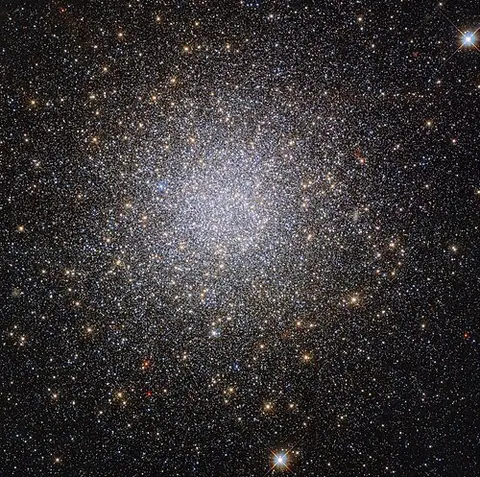
About NGC 2419
NGC 2419 is about 288,551 light-years from the Sun, so the light we see from it left about 288,551 years ago.
It is 313,207 light-years from the centre of the Milky Way.
The map lists it as a globular cluster and shows it at the scale of the Milky Way and the Local Group, drawn on the plane of the Milky Way.
Key numbers
| Distance | 288,551 light-years (88.47 kpc) |
|---|---|
| Distance from the Galactic centre | 313,207 light-years |
| Galactic coordinates | l = 180.37°, b = +25.24° |
| Absolute magnitude (V) | -9.4 |
| Stellar mass | 9.77 × 10⁵ suns |
| Half-light radius | 71 light-years |
Data: Local Volume Database v1.1.1 (Pace 2025).
Where it is
Its place in the universe, from the inside out: Milky Way › Local Group › Virgo Supercluster › Laniakea Supercluster › Observable universe.
Zoom out to see it in context: Satellite galaxies, a view about 2 million light-years across.
From Wikipedia
NGC 2419 is a globular cluster of stars in the constellation Lynx. Alternatively, it is known as Caldwell 25. It was discovered by German-British astronomer William Herschel on December 31, 1788.
Excerpt from the Wikipedia article NGC 2419, licensed CC BY-SA 4.0.
Nearby on the map
- Ursa Major I Dwarf galaxy
- Ursa Major II Dwarf galaxy
- Willman 1 Dwarf galaxy
- Koposov 2 Globular cluster
- Stellar halo (break radius) Galactic structure
- Draco II Dwarf galaxy