 Map of the Universe
Leo Supercluster
Supercluster · Galaxy supercluster
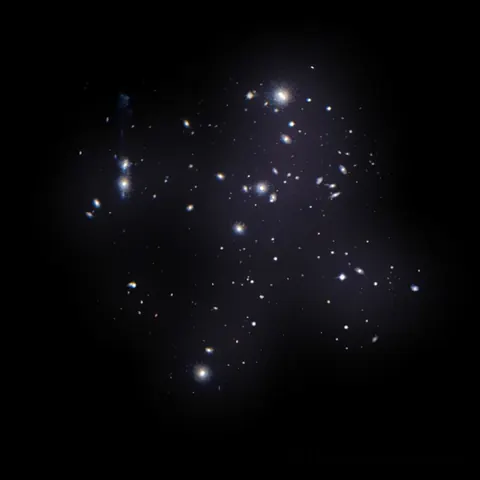
About the Leo Supercluster
The light we see from it set out 0.452 billion years ago, when the universe was 13.3 billion years old (redshift 0.032).
The map lists it as a supercluster and shows it at the scale of the large-scale universe, drawn on the supergalactic plane.
Its distance or nature is debated, and the map shows one published value.
Position approximate.
Key numbers
| Distance (comoving, today) | 0.459 billion light-years (141 Mpc) |
|---|---|
| Redshift z | 0.032 |
| Light travel time | 0.452 billion years |
| Universe's age when this light left | 13.3 billion years |
| Distance method | redshift (Planck 2018 cosmology) |
| Supergalactic coordinates | SGL 80.7°, SGB -13.9° |
| On the map | The dashed circle marks its approximate size around its centre. Structures this large have no sharp edge, and the circle is not drawn to an exact shape. |
| Size | about 196 million light-years across |
Where it is
Its place in the universe, from the inside out: Observable universe.
Zoom out to see it in context: Nearby superclusters, a view about 2.3 billion light-years across.
From Wikipedia
The Leo Supercluster is a supercluster in the northern celestial hemisphere that stretches across the constellations Ursa Major and Leo. It covers an area approximately 130 megaparsecs long by 60 megaparsecs wide. The redshifts of member galaxy clusters range from 0.032 to 0.043.
Excerpt from the Wikipedia article Leo Supercluster, licensed CC BY-SA 4.0.
Nearby on the map
- Leo Cluster Galaxy cluster
- Coma Supercluster Supercluster
- CfA2 Great Wall Large-scale structure
- Coma Cluster Galaxy cluster
- Markarian 231 Quasar / active galaxy
- Hydra Cluster Galaxy cluster