 Map of the Universe
Lacaille 8760
Star · Star in the constellation Microscopium
About Lacaille 8760
Lacaille 8760 is about 12.87 light-years from the Sun, so the light we see from it left about 12.87 years ago.
At apparent magnitude 6.69 it is too faint for the naked eye but within reach of binoculars.
It gives out 0.0286 times as much light as the Sun.
The map lists it as a star and shows it among the stars around the Sun, drawn on the plane of the Milky Way.
Key numbers
| Distance | 12.87 light-years (3.95 pc) |
|---|---|
| Spectral type | M1/M2V |
| Apparent magnitude | 6.69 |
| Absolute magnitude | 8.71 |
| Luminosity | 0.0286 × the Sun |
| Constellation | Mic |
Where it is
Its place in the universe, from the inside out: Solar neighbourhood › Local Bubble › Orion–Cygnus Arm (Local Arm) › Milky Way › Local Group › Virgo Supercluster › Laniakea Supercluster › Observable universe.
Zoom out to see it in context: Nearest stars, a view about 24 light-years across.
From Wikipedia
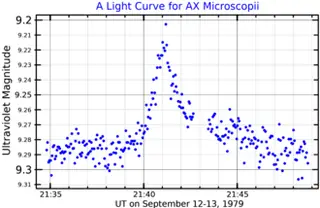
Lacaille 8760 (AX Microscopii) is a red dwarf star in the constellation Microscopium. It is one of the nearest stars to the Sun at about 12.9 light-years' distance, and the brightest M-class main-sequence star in Earth's night sky, although it is generally too faint to be seen without a telescope.
Excerpt from the Wikipedia article Lacaille 8760, licensed CC BY-SA 4.0.
Nearby on the map
- Epsilon Indi Star
- Lacaille 9352 Star
- EZ Aqr Star
- Ross 154 Star
- Gl 1 Star
- Alpha Centauri B Star