 Map of the Universe
Epsilon Eridani
Star · Star in the constellation Eridanus
About Epsilon Eridani
Epsilon Eridani is about 10.49 light-years from the Sun, so the light we see from it left about 10.49 years ago.
At apparent magnitude 3.72 it can be seen with the naked eye from a dark site.
It gives out 0.293 times as much light as the Sun.
It has one known planet.
The map lists it as a star and shows it among the stars around the Sun, drawn on the plane of the Milky Way.
Key numbers
| Distance | 10.49 light-years (3.22 pc) |
|---|---|
| Spectral type | K2V |
| Apparent magnitude | 3.72 |
| Absolute magnitude | 6.18 |
| Luminosity | 0.293 × the Sun |
| Constellation | Eri |
| Known planets | 1 |
Planets: NASA Exoplanet Archive (Planetary Systems Composite Parameters).
Known planets
| Planet | Mass (Earth = 1) | Radius (Earth = 1) | Orbit (days) | Found |
|---|---|---|---|---|
| eps Eri b | 317.828407 | 13.8 | 2680 | 2000, radial velocity |
Where it is
Its place in the universe, from the inside out: Solar neighbourhood › Local Bubble › Orion–Cygnus Arm (Local Arm) › Milky Way › Local Group › Virgo Supercluster › Laniakea Supercluster › Observable universe.
Zoom out to see it in context: Nearest stars, a view about 24 light-years across.
From Wikipedia
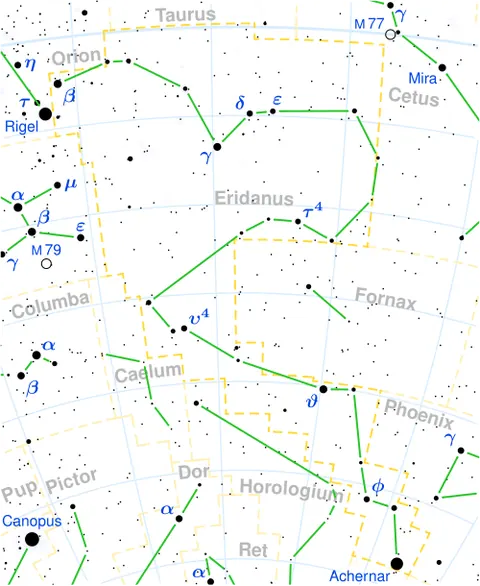
Epsilon Eridani, proper name Ran, is a star in the southern constellation of Eridanus. At a declination of −9.46°, it is visible from most of Earth's surface.
Excerpt from the Wikipedia article Epsilon Eridani, licensed CC BY-SA 4.0.
Nearby on the map
- Tau Ceti Star
- Sirius Star
- Kapteyn's Star Star
- Ross 614 Star
- Van Maanen's Star Star
- Sun's Hill sphere Region / boundary